


Funding Your Special Needs Plan: How the Money Flows
Updated: Jun 19
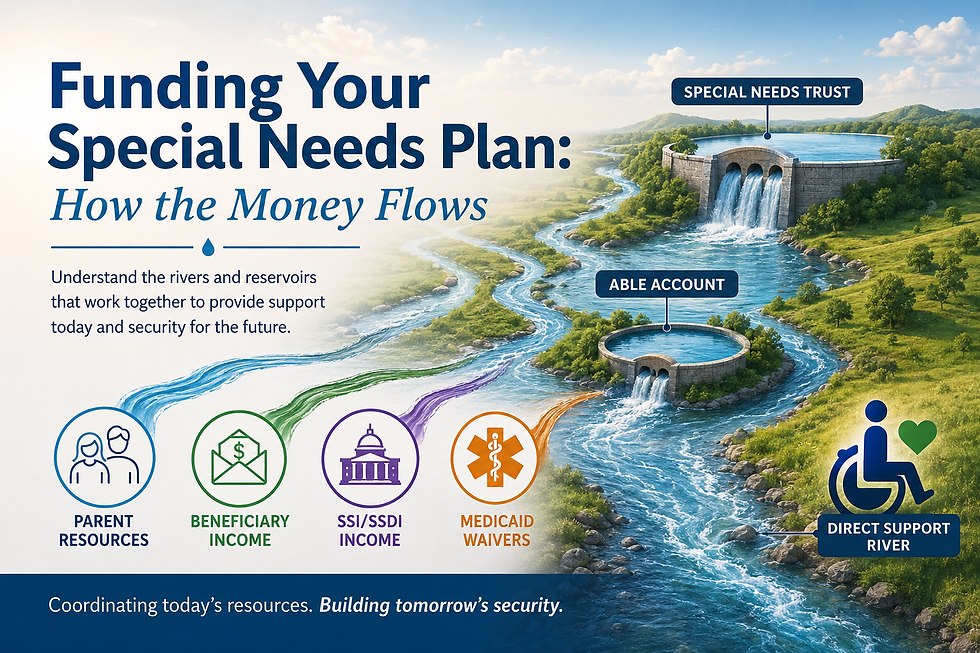
Funding a special needs plan can feel overwhelming. There are a lot of moving parts: parent resources, government benefits, ABLE accounts, special needs trusts, and more. Many families know they should have these tools in place but are not entirely sure how they fit together.
I like to think about special needs funding in terms of rivers and reservoirs.
Rivers represent ongoing sources of income or services that flow in and flow back out as they are used. Reservoirs represent places where resources can be stored for future needs and released when the time is right.
Understanding the difference can make special needs planning much easier.
The Rivers
Parental Resources
For most children with disabilities under the age of 18, parents are the primary source of financial support. Unless a family's financial circumstances (or certain medical conditions) qualify the child for Medicaid, parents generally pay for housing, food, medical expenses, therapies, education, and other day-to-day needs.
In most states, children under age 18 are subject to parental deeming rules for SSI eligibility. As a result, family income and assets often determine whether the child qualifies for benefits.
Many families continue paying expenses directly well into adulthood, either because they choose to or because their special needs trust is designed to receive assets only after the parents' deaths.
Parents can provide direct financial support for as long as they wish. However, paying for housing expenses can reduce SSI benefits through In-Kind Support and Maintenance (ISM) rules, making coordination with the overall plan important.
Individual beneficiary income:
Some individuals with disabilities are able to work and earn their own income. Employment can provide independence, purpose, and improved quality of life.
However, earned income may reduce SSI benefits and, if it becomes substantial enough, can eventually affect Medicaid eligibility. While replacing SSI with earned income is often a positive outcome, losing Medicaid and the services it provides can lead to many more financial and life-support challenges.
For that reason, beneficiary income should be viewed as one part of the overall funding strategy rather than the entire solution.
Government-sourced income (SSI/SSDI):
Government benefits provide an important financial safety net.
Supplemental Security Income (SSI) is a needs-based program for individuals who meet strict disability and financial requirements. In 2026, the maximum federal benefit is $994 per month for an individual and $1,491 for an eligible couple, although many recipients receive less depending on their circumstances.
Because SSI is means-tested, exceeding the applicable income or asset limits can jeopardize eligibility.
Social Security Disability Insurance (SSDI) works differently. Eligibility is based on disability and work history rather than financial need. Benefit amounts depend on prior earnings.
Individuals whose disability began before age 22 may qualify for Disabled Adult Child (DAC) benefits based on a parent's Social Security record once that parent retires, becomes disabled, or dies.
Medicaid/Medicare/Waivers:
Health coverage is often just as valuable as monthly income.
Most SSI recipients also qualify for Medicaid, while SSDI recipients generally become eligible for Medicare after a two-year waiting period.
Beyond medical insurance, Medicaid often funds services that make independent living possible, including day programs, vocational services, residential support, respite care, and other home- and community-based services delivered through Medicaid waiver programs. These programs vary significantly by state but are frequently among the most valuable benefits available.
As long as eligibility requirements continue to be met, these government programs function like a river that keeps flowing throughout the beneficiary's lifetime.
The Reservoirs
Rivers are useful, but they have one major limitation: money flows in and money flows out.
That makes long-term planning difficult.
Parents may eventually run out of resources. Employment income may stop or never be sufficient. Government programs can change, and eligibility can be lost if asset or income limits are exceeded.
That's where reservoirs come in.
Reservoirs allow families to store resources for future needs while preserving eligibility for means-tested benefits.
ABLE accounts
ABLE accounts are state-sponsored investment accounts available to many individuals with disabilities. They function similarly to 529 college savings plans but are designed specifically for disability-related expenses.
Anyone can contribute to an ABLE account, and the funds grow tax-free. Withdrawals used for qualified disability expenses are also tax-free.
Because qualified disability expenses are defined broadly, ABLE accounts provide a flexible source of supplemental spending that can increase independence while preserving government benefits.
They are relatively simple to establish and administer, require no trustee, and are often an excellent first step for many families.
However, annual contribution limits apply, and once the account balance exceeds $100,000, SSI benefits may be suspended until the balance falls below that threshold.
Special Needs Trusts:
Special needs trusts serve as long-term storage reservoirs for larger amounts of money.
Assets held inside a properly drafted trust generally do not count as the beneficiary's personal resources. Instead, they are managed by a trustee who has a fiduciary responsibility to use the funds for the beneficiary's supplemental needs.
Unlike ABLE accounts, special needs trusts have no annual contribution limits or overall balance limits, making them well suited for inheritances, life insurance proceeds, or other significant assets.
However, distributions require more oversight. Payments for housing expenses can trigger SSI reductions under the In-Kind Support and Maintenance rules, making thoughtful coordination essential.
Putting It All Together
The goal is not to force every dollar through a single pathway.
Instead, successful special needs planning coordinates multiple funding sources so they work together.
Parent resources, beneficiary income, government benefits, ABLE accounts, and special needs trusts each have a role to play. When used strategically, they can provide current support, preserve valuable public benefits, and create financial security for decades to come.
The diagram below illustrates how these rivers and reservoirs can work together to support the beneficiary while protecting long-term eligibility for essential programs.

Closing Thought
No two families will build their plan exactly the same way, and the "best" path for one beneficiary may not be appropriate for another. The key is not to maximize any single river or reservoir but to understand how they work together. By coordinating parent resources, government benefits, ABLE accounts, and special needs trusts, you can create a system that provides support today while protecting flexibility and financial security for the future. If you're feeling overwhelmed, remember that you don't have to solve every piece at once. Start by understanding the flow, then build your plan one step at a time.
Continue Learning
If you'd like to dive deeper into these topics, you may also find these resources helpful:
Looking for a Step-by-Step Guide?
If you're just getting started or would like a more comprehensive overview of special needs planning, check out my Special Needs Planning Course. It brings together the key concepts, strategies, and planning considerations into a structured format designed to help families better understand their options and make informed decisions.
Need Personalized Help?
Every family's situation is unique, and coordinating government benefits, ABLE accounts, special needs trusts, and long-term financial planning can be complicated.
If you'd like personalized guidance in building a comprehensive special needs plan for your child or loved one, I'd be happy to help. Schedule a free discovery call, and we can discuss your family's goals and determine whether we're a good fit to work together.
Disclaimer: the material in this blog post is intended for general educational purposes only and should not be considered specific financial advice. You should always consult with your personal financial advisor to see how it might fit within your personalized financial plan.


Comments