


A Beginner's Guide to Government Benefits for Individuals with Disabilities

Introduction
Managing life with a disability is challenging, whether it affects you, your child, your sibling, or someone else you love. For parents especially, each day can feel like a balancing act of therapies, school meetings, doctor's appointments, challenging behaviors, and sometimes simply learning how to communicate with your child in a way that helps them thrive.
Looming over all of that are the bigger questions:
How am I going to keep doing this for the rest of my life?
How am I going to pay for everything my child needs?
What will happen to my child when I'm no longer here?
It's understandable to push those questions to the back of your mind. Most families are focused on getting through today, not planning for decades into the future.
But building a special needs plan doesn't mean you have to solve every problem at once.
There are seasons for each step, and many of the decisions can wait until the time is right. The important thing is to understand your options and begin creating a roadmap so that, as opportunities arise, you can make informed decisions with confidence.
That's what special needs planning is all about.
In previous articles, I've covered some of the key financial tools that families use to build that roadmap:
This article focuses on another foundational piece of the puzzle: government benefits.
Understanding programs like SSI, SSDI, Medicaid, and related supports is essential because they often provide the financial and medical safety net that helps sustain both your child's quality of life and your family's long-term plan. Before deciding how to save or where to direct your resources, it's important to understand how these benefits work and how they fit into the bigger picture. The good news is that once you understand the purpose of each program, the system becomes much less intimidating.
The Three Big Questions Government Disability Benefits Try to Answer
One of the easiest ways to understand government benefits is to think about the question each program is trying to answer.
Question #1: Does this person need financial assistance because they have limited income and assets?
These programs are designed to provide a financial safety net for individuals who meet certain income and asset limits (often referred to as means-tested programs).
Examples include:
SSI (Supplemental Security Income)
Medicaid
Question #2: Has this person (or their parent) earned benefits through work?
Some government benefits are based on a work history rather than financial need. In these cases, eligibility depends on payroll taxes that the individual, or more frequetly the parent, paid into the system over many years.
Examples include:
SSDI (Social Security Disability Insurance)
Disabled Adult Child (DAC) benefits
Medicare
These programs are generally not means-tested.
Question #3: Does this person or family need additional support to successfully live and participate in the community?
Some programs are designed to provide services rather than direct financial assistance. Their goal is to help individuals with disabilities live as independently as possible and participate in school, work, and community life.
Examples include:
Medicaid Waiver programs
Like Medicaid, many of these programs are needs-based, but the services available and the eligibility rules can vary significantly from one state to another.
The Means-tested Benefits
The term “means-tested” simply means that a program is based on financial need. To qualify, an individual must stay below certain income and asset limits. If their financial resources exceed those limits, they may lose eligibility for the benefit.
Because eligibility depends on these financial thresholds, recipients should expect their income and assets to be reviewed regularly to ensure they continue to qualify.
In many ways, means-tested benefits provide a minimum floor, or safety net, of financial support and health care coverage. They are available not only to individuals with disabilities but also to people with limited financial resources who meet the program's eligibility requirements.
For adults with disabilities, qualifying for programs such as SSI requires more than simply having a medical diagnosis. The individual must demonstrate that they are unable to engage in substantial gainful activity (essentially, work that provides meaningful earnings) because of a medically determinable physical or mental impairment that is expected to last at least 12 months or result in death.
One of the most common misconceptions is that qualification is based solely on a diagnosis. It is not. While certain conditions may qualify automatically under Social Security's rules, most disability determinations are based on functional limitations—how the condition affects a person's ability to perform work and other daily activities.
When applying for SSI, it is therefore essential to describe not only the diagnosis but also how the disability limits the individual's functioning and prevents them from engaging in substantial gainful activity.
The two most common means-tested programs that families encounter are Supplemental Security Income (SSI) and Medicaid, both of which we'll discuss below.
Supplemental Security Income (SSI)
Supplemental Security Income (SSI) is a monthly cash benefit designed to help individuals with disabilities pay for basic living expenses. It is intended to provide a modest monthly paycheck for necessities such as housing, food, and clothing.
The amount of the monthly SSI payment depends on several factors, including:
The government-established maximum benefit. (For 2026, the federal maximum is $994 per month for an eligible individual and $1,491 per month for an eligible couple.)
The beneficiary's own income. Earned and unearned income can reduce the monthly SSI payment according to Social Security's income calculation rules.
Housing support provided by others. If someone else pays certain housing expenses for the beneficiary, that assistance may reduce the SSI benefit under the rules for In-Kind Support and Maintenance (ISM). Recent changes to the law mean that food assistance no longer counts toward ISM, leaving housing support as the primary consideration.
Basic Eligibility Requirements for SSI
To qualify for SSI as an adult, an individual generally must:
Have a disability that prevents substantial gainful activity and is expected to last at least 12 months (or result in death).
Have countable assets below the program limits (currently $2,000 for an individual and $3,000 for an eligible couple in 2026).
Meet SSI's income requirements, recognizing that most income will reduce the monthly benefit.
Be at least 18 years old, unless the family itself also meets the program's financial eligibility rules for a child receiving SSI.
Once approved, the individual receives a monthly payment from the Social Security Administration. Beneficiaries are responsible for reporting changes in income, assets, and certain living arrangements, and Social Security periodically reviews eligibility to ensure the requirements continue to be met.
In most states, qualifying for SSI also makes an individual eligible for Medicaid. In some states, enrollment is automatic, while in others a separate Medicaid application is required.
Medicaid
As mentioned above, in most states, qualifying for SSI also makes an individual eligible for Medicaid. While SSI provides cash assistance, Medicaid provides health insurance coverage.
Medicaid helps pay for medical care for individuals who qualify based on financial need, disability, or other eligibility categories established by federal and state law. For many individuals with disabilities, it serves as the foundation of their health care coverage and provides access to services that may not be available (or affordable) through private insurance.
Although Medicaid coverage varies somewhat from state to state, it generally includes services such as:
Physician visits
Hospital care
Prescription medications
Outpatient therapies
Preventive services
Long-term supports and services (including many Medicaid Waiver programs discussed below)
Because Medicaid is jointly funded by the federal government but administered by each state, eligibility rules and covered services can differ significantly depending on where you live.
For many families, preserving Medicaid eligibility is just as important, if not more important, than preserving the monthly SSI benefit. A person with a disability may eventually earn enough income or receive enough financial support so that SSI payments are reduced or eliminated, but obtaining comparable health coverage and long-term support services through private insurance may be impossible or prohibitively expensive.
As we'll discuss in the next section, Medicaid provides far more than medical insurance alone. Through its Waiver programs, it often funds services that allow individuals with disabilities to live safely in their homes, participate in their communities, and achieve a much greater degree of independence.
Medicaid Waivers
So far, we've discussed means-tested benefits that provide a modest monthly income (SSI) and basic health insurance coverage (Medicaid). But for many families, the most valuable Medicaid benefit isn't the health insurance at all—it's the Medicaid Waiver program.
Medicaid Waiver programs provide funding for services that help individuals with disabilities live and participate in their communities rather than requiring institutional care. While each state designs and administers its own waiver programs, the overall goal is the same: to provide the support needed for people with disabilities to live the most independent and fulfilling lives possible.
In the past, many individuals with significant disabilities lived in large residential institutions, while other families simply managed (and paid for) everything on their own. Over time, policymakers recognized that supporting individuals in community-based settings was often both more effective and more desirable than relying primarily on institutional care.
Depending on the state and the specific waiver, covered services may include:
Residential supports (including host homes, group homes, supervised living arrangements, or assistance in a private residence)
Day programs
Respite care for family caregivers
Supported living services
Transportation assistance
Employment supports, such as job coaching and workplace assistance
Adaptive equipment and other disability-related services
For most families, paying for these services out of pocket would simply be impossible. Yet these supports often make the difference between isolation and community involvement, dependence and independence, or caregiver burnout and a sustainable long-term plan.
Unfortunately, Medicaid Waiver services are generally considered optional benefits under federal law rather than mandatory ones. As a result, states frequently limit enrollment based on available funding, and waiting lists can stretch for years—or even decades.
For that reason, families should learn about their state's waiver programs and apply as early as possible whenever their loved one may qualify.
Non Means-tested Benefits
Everything we've discussed so far has involved means-tested programs. In other words, eligibility depends on an individual's financial situation. If income or assets exceed the program's limits, benefits may be reduced or lost.
Fortunately, not all government disability benefits work this way.
Some programs are based not on financial need but on a person's (or a parent's) work history and the payroll taxes they have paid into the system over many years. For these benefits, income and assets generally do not determine eligibility.
These programs answer the second major question we introduced earlier:
Has this person (or their parent) earned benefits through work?
Let's look at those next.
Social Security Disability Insurance (SSDI)
Although SSDI sounds very much like SSI, the two programs are fundamentally different. SSI stands for Supplemental Security Income and is a needs-based assistance program. SSDI stands for Social Security Disability Insurance. It is an insurance benefit--not just income support for those who have no resources.
Think of it this way. If you obtained private disability insurance for your occupation and paid the premiums every month and then became disabled, you would have no problem accepting a monthly check from your insurance company, right? Well, SSDI is similar. Instead of paying a private insurance company, though, you have been paying the government a premium for that insurance.
When did you pay that premium? Every time the government took FICA taxes out of your paycheck. Part of the tax is used to support this program. So you are eligible for it because you paid into it.
But, like most things, the government has its own definition of disability, and it is often much stricter than your private disability insurance. To qualify, and like with SSI, you need to demonstrate that you are unable to perform any substantial gainful activity because of your disability and it must be expected to last for a continuous period of at least 12 months or is expected to result in death.
Also, you must have earned enough Social Security work credits through prior employment. The exact number of credits required depends on your age when you become disabled.
If you have earned enough work credits and your disability meets Social Security's definition, the government essentially begins paying your Social Security retirement benefit early, based on your earnings record up to the time you became disabled. So if you have worked long enough, your monthly SSDI benefit is often substantially larger than the maximum SSI payment, sometimes by a couple of thousand dollars a month.
What if my child has never worked?
Fortunately, Congress recognized that some individuals become disabled before they ever have the opportunity to build their own work history. To address that problem, it created the Disabled Adult Child (DAC) benefit.
Under federal law, if an individual's qualifying disability began before age 22, they may be eligible for Childhood Disability Benefits (CDB) based on a parent's Social Security earnings record rather than their own. Once that parent begins collecting Social Security retirement or disability benefits—or dies—a qualifying DAC may receive a monthly benefit based on the parent's work history.
The exact amount can be complicated because it is subject to family maximum benefit rules. However, as a general rule of thumb, the benefit is often 50% of the parent's Full Retirement Age benefit while the parent is living and up to 75% after the parent's death.
To recap, the major advantages of SSDI are:
The monthly benefit is often substantially larger than an SSI payment.
It is not means-tested, so assets and income generally do not affect eligibility.
It qualifies the recipient for Medicare (discussed below).
One potential drawback, however, is that a larger SSDI benefit may reduce or eliminate SSI eligibility and can complicate Medicaid eligibility, depending on the individual's circumstances and the state in which they live.
Is that really a problem if the monthly income is higher and the health insurance is better?
At first glance, it might not seem like one. But it can be.
The biggest concern is that losing SSI eligibility may also jeopardize Medicaid eligibility and, more importantly, the valuable Medicaid Waiver services that often accompany it. Fortunately, there are planning strategies that can help preserve those benefits, and we'll discuss those later in this article.
Medicare
Like Medicaid, Medicare is a federal health insurance program. Most people associate it with retirement and eligibility at age 65, but it also provides coverage for many individuals who qualify for Social Security Disability Insurance (SSDI).
In most cases, a person who receives SSDI becomes eligible for Medicare after a 24-month waiting period from the start of their SSDI entitlement. (There are a few exceptions to this rule for certain medical conditions.)
Although Medicare generally offers excellent medical coverage, it serves a different role than Medicaid. Beneficiaries are often responsible for premiums and cost-sharing, particularly for Medicare Part B (outpatient medical services) and Medicare Part D (prescription drug coverage). Medicaid, by contrast, typically requires little or no premium from eligible individuals.
Perhaps even more importantly, Medicare does not provide the long-term support services funded through Medicaid Waiver programs. As a result, many individuals with disabilities benefit from maintaining eligibility for both Medicare and Medicaid whenever possible.
The next section explains one of the most important planning strategies for preserving those valuable Medicaid benefits.
How Do You Keep Medicaid While Receiving SSDI?
At this point, you may be wondering:
If SSDI pays a larger monthly benefit and provides Medicare coverage, why would anyone worry about losing SSI or Medicaid?
The answer is simple: because Medicaid often provides benefits that Medicare does not.
For many individuals with disabilities, the most valuable government benefit isn't the monthly SSI check or even health insurance coverage. It is access to Medicaid-funded Waiver services that pay for supported living, residential programs, employment assistance, day programs, respite care, transportation, and other long-term supports.
Losing access to those services can have a much greater impact on quality of life than losing the SSI cash benefit itself.
Fortunately, Congress also recognized that individuals should not have to lose valuable Medicaid services simply because they become eligible for DAC benefits.
Under a provision commonly referred to as the DAC Medicaid protection, individuals who lose SSI solely because they begin receiving DAC benefits can often continue to qualify for Medicaid. In effect, Medicaid eligibility may be determined as though the DAC benefit did not exist.
This protection allows many adults with disabilities to receive:
A larger monthly DAC benefit based on a parent's work history,
Medicare coverage through SSDI, and
Continued Medicaid eligibility, including valuable Waiver services.
Not every situation qualifies for these protections, and the rules vary depending on the individual's circumstances and state of residence. However, for many families, this coordination between SSDI, Medicaid, and DAC benefits forms the foundation of a successful long-term special needs plan.
Understanding how these programs interact is one of the reasons careful planning is so important. A decision that appears beneficial on the surface can sometimes have unintended consequences if the impact on other benefits is not considered.
How These Programs Can Work Together
Now that we've looked at each government benefit individually, it's easier to see how they fit together as part of a comprehensive special needs plan.
For many individuals with lifelong disabilities, the journey begins with SSI and Medicaid. SSI provides a modest monthly income, while Medicaid provides health insurance and, perhaps more importantly, access to valuable Medicaid Waiver services. Because these programs are means-tested, families often use ABLE accounts and Special Needs Trusts to hold additional assets without jeopardizing eligibility.
Later in life, another opportunity may arise. If the individual's disability began before age 22 and they otherwise qualify as a Disabled Adult Child (DAC), they may become eligible for Childhood Disability Benefits (CDB) based on a parent's Social Security work record once that parent retires, becomes disabled, or dies. Those DAC benefits are often significantly larger than an SSI payment and eventually lead to Medicare eligibility.
At first glance, it might seem that SSI and Medicaid are no longer important. In reality, however, preserving Medicaid eligibility often remains a critical planning objective because of the long-term support services and Medicaid Waiver benefits it can provide. For that reason, families frequently continue using Special Needs Trusts and ABLE accounts to protect assets and help maintain eligibility whenever possible.
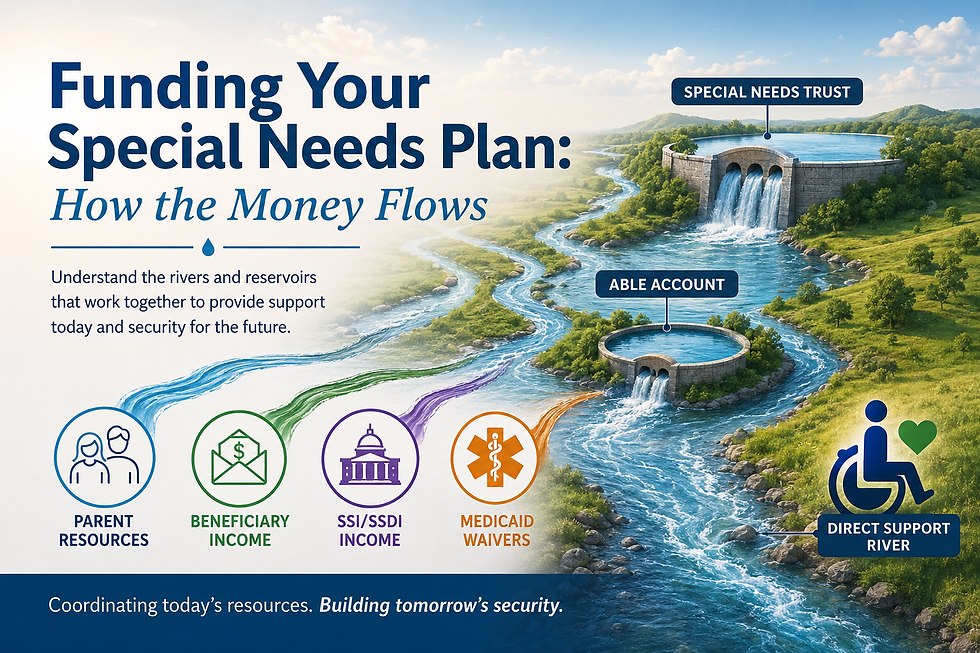
If this interaction between income sources, trusts, and benefit programs seems complicated, don't worry—you are not alone. In my article, "Funding Your Special Needs Plan: How the Money Flows," I use an analogy of rivers and reservoirs to illustrate how these different pieces work together and why each plays an important role in a successful long-term plan.
Conclusion
At first glance, the government benefits system can seem overwhelming. Between SSI, SSDI, Medicaid, Medicare, Waiver programs, DAC benefits, ABLE accounts, and Special Needs Trusts, it's easy to feel like you're drowning in acronyms.
But underneath all of those programs is a fairly simple idea: they were created to answer different questions. Some provide a financial safety net for those with limited resources. Some provide insurance benefits that have been earned through work. Others exist to help individuals with disabilities live meaningful lives in their communities with the support they need.
The key is understanding how those pieces fit together.
You don't have to build the entire plan today. In fact, many of the decisions discussed in this article won't become relevant for years. But by learning the basics now, you'll be prepared to make informed decisions as new opportunities arise and your family's circumstances change.
Most importantly, remember that these programs are only tools. The ultimate goal isn't simply to maximize government benefits—it's to create a life that is safe, meaningful, and sustainable for the person you love.
If you're ready to take the next step and build a comprehensive roadmap for your family's future, consider enrolling in my Special Needs Planning Course. It brings together these concepts and many others into a step-by-step framework designed to help parents and caregivers make informed decisions with confidence and create a long-term plan for the person they love.
Disclaimer: the material in this blog post is intended for general educational purposes only and should not be considered specific financial advice. You should always consult with your personal financial advisor to see how it might fit within your personalized financial plan.


Comments